

Swimming pools come in different shapes and sizes, and their surrounding environments are rarely identical. While standard safety pool covers can work well for many rectangular pools, they may not provide the best fit for pools with unusual dimensions, curved edges, steps, or built-in features.
This raises an important question: Are custom safety pool covers worth the additional investment?
In many situations, the answer is yes. A properly designed custom cover can provide a closer fit, accommodate unique pool layouts, and help maintain consistent coverage. However, its value depends on the pool's structure, the intended use, and whether the cover meets appropriate safety requirements.
When Does a Pool Need a Custom Safety Cover?
Standard pool covers are generally manufactured in common sizes and shapes. They can be a practical option for conventional swimming pools, but certain designs create fitting challenges.
For example, a pool with rounded corners, curved sides, attached steps, or an irregular outline may leave uncovered gaps when a standard cover is used. These gaps can affect the overall coverage and make proper installation more difficult.
Custom safety pool covers are designed around the actual dimensions and layout of a particular pool. This makes them especially useful in several situations:
▶ Irregular pool shapes: Pools with kidney-shaped, oval, freeform, or curved outlines may require a specially shaped cover.
▶ Built-in features: Integrated steps, raised walls, and other structural elements can make standard sizing less suitable.
▶ Unusual dimensions: Very large or unusually proportioned pools may need a cover designed specifically for their measurements.
▶ Specific installation layouts: The position of surrounding decking, walls, and anchor points may influence the cover design.
A custom cover is not automatically necessary for every swimming pool. If a standard safety cover fits correctly and meets the relevant safety requirements, it may be a perfectly suitable choice.
What Are the Main Advantages of Custom Safety Pool Covers?
The biggest advantage of customization is that the cover can be designed to match the pool rather than forcing the pool to fit a standard product.
1. Better Fit and More Complete Coverage
Accurate measurements allow a custom safety pool cover to follow the pool's outline more closely. This is particularly important for pools with curved edges or unusual configurations.
A properly fitted cover helps reduce unnecessary gaps around the perimeter and allows the anchoring system to be positioned according to the pool's actual layout.
However, a close visual fit alone does not guarantee safety. The cover must also be correctly tensioned, securely anchored, and installed according to its design specifications.
2. Greater Flexibility in Design
Custom covers can accommodate different pool shapes, dimensions, and installation conditions.
Depending on the design, customization may involve the cover's overall dimensions, shape, material, color, and anchor placement. This flexibility makes it easier to address structural limitations that standard covers may not accommodate.
It is important to remember that appearance should never take priority over structural performance. Any design changes must remain consistent with the cover's tested specifications and intended application.
3. More Suitable Material Selection
Not all swimming pools face the same environmental conditions.
A pool exposed to strong sunlight may require a material with suitable UV resistance, while pools surrounded by trees may experience frequent contact with leaves, branches, and other debris.
Safety pool covers are commonly available in mesh and solid constructions. Mesh designs allow water to drain through the material, while solid designs generally provide a more continuous barrier against debris and sunlight, depending on their construction and drainage system.
Choosing between them requires considering local weather, drainage arrangements, maintenance requirements, and the manufacturer's safety specifications.
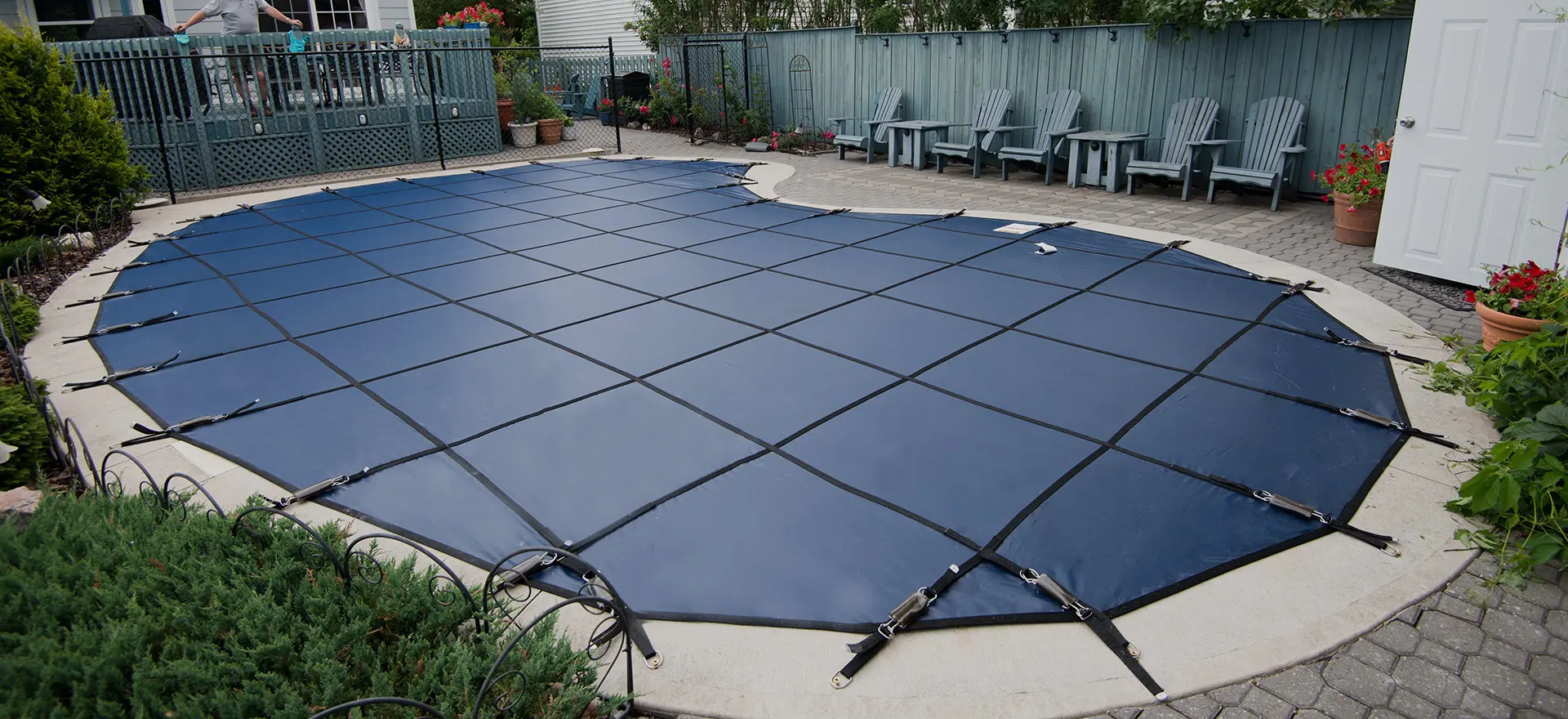
Custom Safety Pool Covers vs. Standard Covers
Both options can provide effective pool protection when correctly selected and installed. The main difference is how well each design accommodates the pool's dimensions and surrounding structure.
| Comparison | Custom Safety Pool Cover | Standard Safety Pool Cover |
| Pool shape | Designed for specific layouts | Best suited to common shapes |
| Dimensions | Made to specified measurements | Available in standard sizes |
| Installation | Requires accurate measurement and planning | Usually more straightforward |
| Design flexibility | Greater customization options | More limited |
| Cost | Generally higher | Often more economical |
For a conventional rectangular pool, a standard cover may offer sufficient coverage without additional customization.
For a pool with unusual dimensions or architectural features, a custom solution may provide better fitting and installation flexibility. The decision should be based on the actual pool layout rather than the assumption that a more expensive cover is always safer.
What Should You Check Before Ordering a Custom Pool Cover?
Customization begins with accurate measurements, but several other details also influence the final result.
Pool dimensions and surrounding structure
The pool's length, width, shape, corner radius, and built-in features should all be documented. The surrounding deck must also be assessed because anchor placement depends on the available installation surface.
Incorrect measurements can lead to fitting problems, excessive tension, or unsuitable anchor positions.
Material and construction
Fabric strength, stitching quality, UV resistance, and overall construction all affect how a safety cover performs over time.
Rather than relying on descriptions such as heavy-duty or premium, check the manufacturer's technical specifications and relevant test documentation. The cover should be suitable for its intended pool configuration and environmental conditions.
Anchoring and installation
Anchors, springs, straps, and other fastening components form part of the overall safety system. Their placement and installation must follow the manufacturer's instructions.
A strong fabric cannot compensate for weak anchoring or an unsuitable installation surface. For this reason, professional measurement and installation are particularly important for complex pool layouts.
Important Safety Considerations
A safety pool cover can be an important part of a swimming pool's protection system, but it should never be treated as a substitute for active supervision or other safety measures.
Before using a custom safety pool cover, keep the following precautions in mind:
▶ Choose a cover specifically designed and tested as a safety cover, not an ordinary debris or winter cover.
▶ Check that the product meets applicable safety standards, such as ASTM F1346 where relevant.
▶ Follow the manufacturer's instructions for installation, tensioning, inspection, and maintenance.
▶ Keep children and pets away from the pool during cover installation and removal.
▶ Never allow anyone to walk, play, or deliberately jump on the cover unless the manufacturer explicitly permits the specific activity under defined conditions.
▶ Inspect the fabric, stitching, anchors, springs, and surrounding installation points regularly for damage or loosening.
Most importantly, a pool cover does not eliminate drowning risks. A properly installed safety cover should be used alongside appropriate pool barriers, self-closing and self-latching gates where required, and constant adult supervision whenever children are near water.
Is the Extra Cost of a Custom Safety Pool Cover Justified?
The value of a custom safety pool cover depends largely on how difficult it is to accommodate the pool with a standard design.
For a typical rectangular swimming pool, a standard cover may be sufficient. However, for pools with irregular shapes, integrated steps, unusual dimensions, or challenging installation conditions, customization can help achieve more appropriate coverage and anchoring arrangements.
Although custom covers generally involve higher initial costs and more detailed installation planning, a suitable fit can make everyday use and seasonal protection more practical.
Ultimately, the best safety pool cover is not necessarily the most expensive or the most customized one. It is the cover that matches the pool's structure, meets the appropriate safety requirements, and is installed and maintained correctly.